

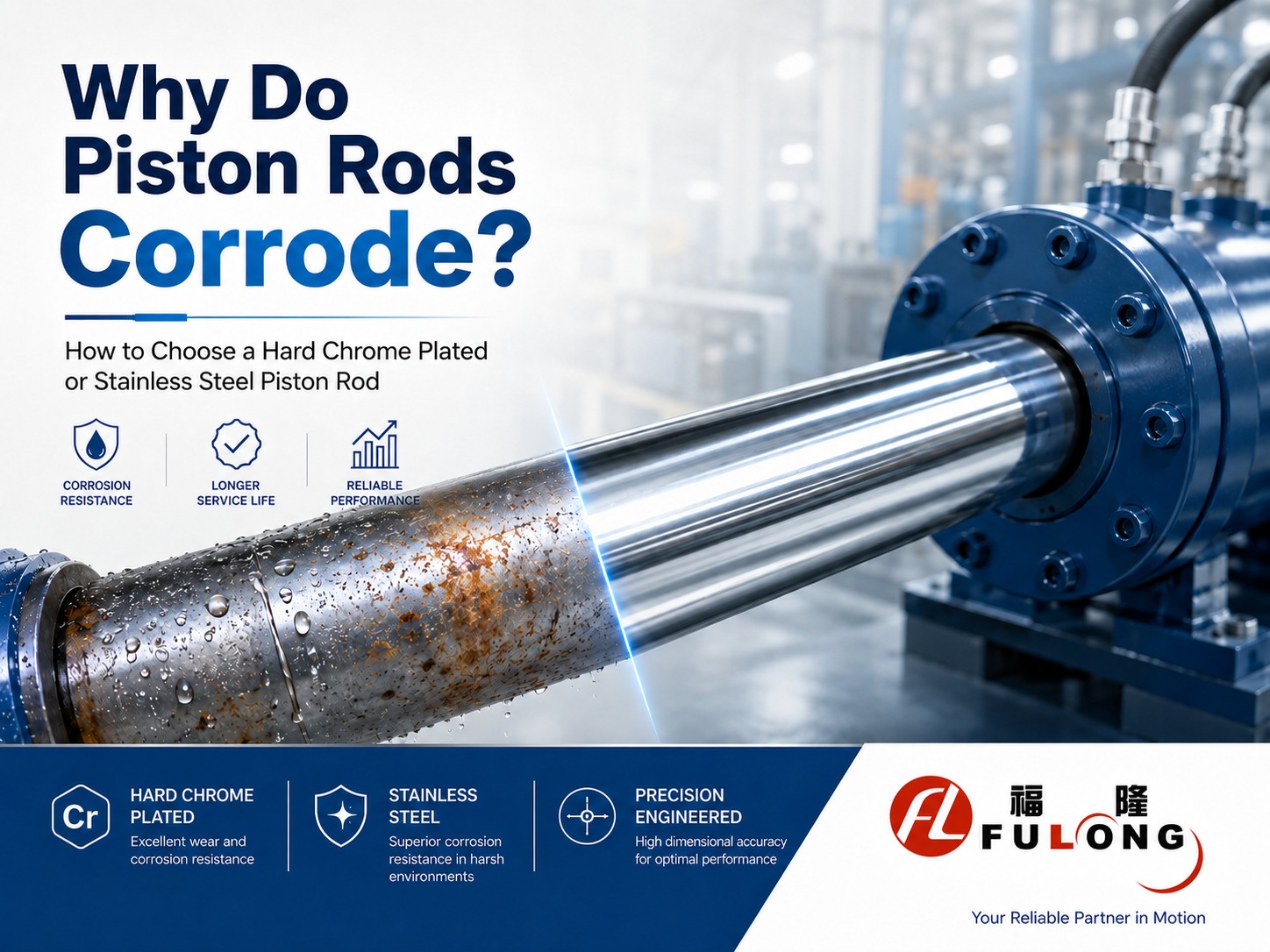
A piston rod may look like a simple polished metal shaft, but its surface condition directly affects hydraulic cylinder performance. Once corrosion, pitting, scratches, or other surface damage develops, the rod may accelerate seal wear, increase the risk of hydraulic leakage, and shorten the service life of the entire cylinder.
For manufacturers of hydraulic cylinders, construction equipment, lifting systems, agricultural machinery, injection molding machines, and industrial automation equipment, selecting the right piston rod requires more than choosing a diameter and length. The operating environment, mechanical load, moisture, chemicals, surface finish, and required corrosion resistance should all be considered.
So, when is a hard chrome plated piston rod suitable, and when should buyers consider a stainless steel piston rod or another corrosion-resistant solution?
This guide explains why piston rods corrode, how different operating environments affect material selection, and what buyers should check before specifying a rod for an industrial application.
Why Piston Rod Corrosion Can Cause Hydraulic Cylinder Problems
A hydraulic piston rod repeatedly passes through seals, wipers, and guide components as the cylinder extends and retracts. Because of this continuous contact, the condition of the rod surface directly affects sealing performance and smooth movement.
When corrosion creates pits or an uneven surface, it can increase friction, compromise sealing and wiping performance, and increase the risk of contaminant ingress.
- Premature seal wear
- Hydraulic fluid leakage
- Increased friction during rod movement
- Surface scoring
- More frequent maintenance
- Unexpected equipment downtime
- Shorter hydraulic cylinder service life
This is why piston rod corrosion should not be viewed as only a cosmetic issue.
A piston rod should not be selected only by diameter, length, and strength. Moisture, salt, chemicals, contaminants, operating cycles, storage conditions, and surface damage can all influence long-term performance.
What Causes a Hydraulic Piston Rod to Corrode?
Piston rod corrosion is usually influenced by a combination of environmental exposure, surface condition, and material selection.
1. Moisture, Rain, and Humidity
Outdoor construction equipment, agricultural machinery, lifting equipment, and other exposed systems may regularly encounter rain, condensation, humidity, or water.
If moisture remains on the rod surface for extended periods, corrosion risk can increase, particularly when equipment remains idle for long periods.
2. Salt and Chloride Exposure
Marine, coastal, offshore, and road-service environments can expose piston rods to salt or chloride-containing substances.
These conditions are generally more aggressive than ordinary indoor industrial environments and may require greater corrosion resistance.
However, material suitability should not be determined by the words "marine" or "chloride" alone. Chloride concentration, temperature, exposure duration, frequency of wetting, maintenance conditions, and other environmental factors can all affect corrosion performance.
3. Chemical Exposure
Equipment used in chemical processing, wastewater treatment, petrochemical facilities, food processing, or other specialized industrial environments may encounter acids, alkalis, cleaning chemicals, or other corrosive substances.
The correct material depends on the actual chemical substance, concentration, temperature, and exposure duration.
A general statement such as "chemical resistant" is therefore not sufficient for proper material selection.
4. Damage to the Chrome-Plated Surface
A chrome plated rod can be damaged by scratches, impact, improper handling, abrasive particles, or severe mechanical contact.
Once the protective surface is compromised, the underlying material may become more vulnerable to moisture and corrosive substances.
This is especially important in construction and mining equipment, where piston rods may operate in dusty, muddy, abrasive, and high-impact conditions.
5. Material Selection That Does Not Match the Application
A piston rod suitable for an indoor factory may not provide the same service life in a coastal, chemical, continuously wet, or heavily contaminated environment.
In some cases, corrosion does not necessarily mean the product was poorly manufactured. The original material, surface treatment, or corrosion-resistance level may simply have been unsuitable for the actual operating conditions.
Instead of asking only, "Will this piston rod rust?" buyers should ask: What will the rod be exposed to, how frequently will exposure occur, how severe are the conditions, and what service life is expected?
When Is a Hard Chrome Plated Piston Rod the Right Choice?
A hard chrome plated piston rod is widely used in hydraulic and pneumatic cylinders because it combines the strength of a steel base material with a hard, smooth, and wear-resistant surface.
Typical applications include:
- Hydraulic cylinders
- Pneumatic cylinders
- Construction machinery
- Agricultural equipment
- Lifting platforms
- Injection molding machines
- Industrial automation equipment
For many general industrial applications, a properly specified hard chrome plated piston rod offers a practical combination of:
- Mechanical strength
- Surface hardness
- Wear resistance
- Smooth movement
- Dimensional accuracy
- Corrosion protection
- Cost efficiency
However, not every hard chrome plated rod provides the same performance.
Buyers should also evaluate:
- Base steel grade
- Chrome layer requirements
- Surface roughness
- Dimensional tolerance
- Straightness
- Hardness
- Corrosion exposure
- Mechanical load
FU-LONG provides hard chrome plated steel bars in materials including S45C , S55C, 20MnV6 , and 38MnVS6 , together with induction-hardened options for applications requiring higher surface strength and greater wear resistance.
Hard chrome plating alone does not determine piston rod performance. The base material, plating quality, dimensional accuracy, surface condition, and application environment must work together.
When Should You Consider a Stainless Steel Piston Rod?
A stainless steel piston rod may be considered when equipment operates in environments involving frequent moisture, chlorides, chemicals, washdown, or other demanding corrosive conditions.
However, hard chrome plating and stainless steel should not always be viewed as competing alternatives.
A stainless steel base material can also be hard chrome plated. FU-LONG provides:
This means buyers can select a stainless steel base material while also benefiting from the surface characteristics of hard chrome plating.
A stainless steel-based solution may be considered for:
- Marine or coastal equipment
- Frequent water exposure
- Chloride-containing environments
- Chemical processing equipment
- Petrochemical applications
- Food-processing machinery, subject to application-specific hygiene and regulatory requirements
- Medical equipment where the selected material and surface specification meet application-specific requirements
- Applications requiring higher cleanliness or corrosion resistance
Among common stainless steel grades, SUS 316 is often considered for applications requiring greater corrosion resistance than SUS 304, particularly in certain chloride-containing environments.
However, suitability still depends on factors such as:
- Chloride concentration
- Temperature
- Exposure duration
- Frequency of wetting
- Mechanical requirements
- Maintenance conditions
- Other chemicals present in the environment
Higher corrosion resistance does not automatically mean a material is the best or most economical choice for every project.
Hard Chrome Plated vs. Stainless Steel Piston Rod: How Should You Choose?
The best choice depends on the actual application rather than simply deciding which material is "better."
| Selection Factor | Hard Chrome Plated Carbon or Alloy Steel Piston Rod | Stainless Steel-Based Piston Rod |
|---|---|---|
| Typical environment | General industrial, hydraulic, pneumatic, construction, and automation applications | Wet, coastal, marine, chemical, or corrosion-sensitive environments |
| Corrosion resistance | Suitable for many industrial environments when properly specified and maintained | Generally provides stronger base-material corrosion resistance, depending on the selected stainless steel grade |
| Wear performance | Hard chrome surface provides strong wear resistance | Can also be hard chrome plated when additional surface performance is required |
| Mechanical properties | Multiple carbon and alloy steel grades are available for different loads | Depend on the stainless steel grade selected |
| Cost consideration | Often economical for general industrial applications | Usually selected when higher corrosion resistance justifies greater material cost |
| FU-LONG options | S45C, S55C, 20MnV6, 38MnVS6, and induction-hardened versions | SUS 303, SUS 304, and SUS 316 hard chrome plated steel bars |
This is especially important because an unnecessarily expensive material may increase project cost without creating meaningful benefits, while an under-specified material may lead to premature corrosion, seal damage, leakage, and more frequent maintenance.
How to Match Piston Rod Materials to Different Operating Environments
A practical way to narrow down piston rod selection is to start with the actual working environment.
Indoor General Industrial Equipment
For equipment operating indoors under controlled conditions, standard hard chrome plated carbon or alloy steel may provide a suitable combination of performance and cost.
Typical examples include:
- Factory automation
- General hydraulic systems
- Machine tools
- Injection molding machinery
- Industrial production equipment
Outdoor Construction and Agricultural Machinery
Outdoor equipment may be exposed to rain, humidity, mud, dust, temperature changes, and abrasive particles.
For these applications, buyers should consider not only corrosion resistance but also:
- Mechanical load
- Surface wear
- Impact risk
- Contamination
- Storage conditions
- Maintenance frequency
Coastal and Marine Equipment
Salt and chlorides create more aggressive corrosion conditions.
Depending on the actual exposure level, possible solutions may include:
- Higher-corrosion-resistant hard chrome plated products
- Stainless steel base materials
- SUS 316 hard chrome plated steel bars
- More demanding corrosion-resistance requirements
The correct choice still depends on chloride concentration, temperature, duration of exposure, maintenance practices, and expected service life.
Chemical and Petrochemical Applications
Material selection should be based on the actual chemical substance rather than a general claim such as "chemical resistant."
Important factors include:
- Type of chemical
- Concentration
- Temperature
- Exposure duration
- Cleaning frequency
- Mechanical load
Applications Requiring Higher Corrosion Resistance Without Automatically Switching to Stainless Steel
Not every corrosive environment automatically requires a stainless steel piston rod.
FU-LONG also provides a High Corrosion Resistant Hard Chrome Plated Steel Bar for applications requiring enhanced corrosion resistance.
This product achieves a minimum Rating 9 after 120 hours of ISO 9227 NSS salt spray testing under SGS certification. Customized corrosion-resistance requirements involving 200-hour or 500-hour salt spray testing can also be discussed according to specific application needs.
This gives buyers another corrosion-resistant option to evaluate alongside standard hard chrome plated steel and stainless steel-based solutions.
Piston rod selection is not limited to only two choices. Standard hard chrome plated steel, high-corrosion-resistant hard chrome plated steel, and stainless steel-based hard chrome plated materials can each be evaluated according to different operating conditions.
What Specifications Should Buyers Confirm Before Ordering a Piston Rod?
Selecting the material is only one part of ordering a piston rod. Buyers should also clearly define the technical requirements that influence fit, wear, sealing, and long-term operation.
Material Grade
The material should be selected according to mechanical load, corrosion conditions, processing requirements, and project cost.
Diameter and Length
The required outside diameter and total length should be clearly specified, including any machining allowance where necessary.
Dimensional Tolerance
Tolerance affects assembly, guidance, movement, and compatibility with other cylinder components.
Surface Roughness
Because the rod repeatedly passes through sealing elements, surface condition is especially important for hydraulic applications.
Chrome Layer and Surface Treatment Requirements
Chrome thickness, hardness, and other surface requirements should be determined according to the intended application.
Straightness and Roundness
These factors may be particularly important for long rods, precision motion systems, and applications where alignment is critical.
Common Material Options Available from FU-LONG
Actual Operating and Corrosion Exposure
Buyers should clearly describe the real working conditions, including:
- Moisture
- Rain
- Salt or chloride exposure
- Chemicals
- Cleaning conditions
- Temperature
- Contaminants
- Storage conditions
A useful RFQ should include more than diameter and length. Material grade, tolerance, surface finish, surface treatment, mechanical load, operating environment, and corrosion exposure can all affect the correct product specification.
FU-LONG Piston Rod and Corrosion-Resistant Material Solutions
FU-LONG METAL INDUSTRIAL CO., LTD. manufactures hard chrome plated steel bars and piston rod materials for hydraulic cylinders, pneumatic cylinders, machinery components, and heavy-duty industrial applications.
Our product range covers standard, induction-hardened, stainless steel, hollow, special-material, and high-corrosion-resistant solutions.
Standard and Induction-Hardened Piston Rod Materials
We provide:
Special and Corrosion-Resistant Materials
Our additional material options include:
We can support requirements involving material grade, dimensional tolerance, surface finish, chrome thickness, hardness, length, and customized industrial applications.
For buyers comparing a hard chrome plated piston rod, a stainless steel piston rod, or another corrosion-resistant solution, the most suitable choice should be based on both mechanical requirements and the actual operating environment.
View the complete Piston Rod / Linear Shaft product range.
Frequently Asked Questions About Piston Rod Corrosion and Material Selection
Can a Hard Chrome Plated Piston Rod Still Corrode?
Yes. Hard chrome plating improves corrosion resistance, but actual performance depends on the coating condition, surface quality, base material, operating environment, maintenance, and exposure to corrosive substances.
If the surface is damaged or the environment exceeds the corrosion resistance of the selected product, corrosion may still occur.
Does Every Outdoor Hydraulic Cylinder Need a Stainless Steel Piston Rod?
No. Outdoor exposure alone does not automatically mean stainless steel is necessary.
The correct choice depends on the frequency of moisture exposure, chloride or salt exposure, contaminants, storage conditions, maintenance practices, required service life, and mechanical load.
In some cases, a high-corrosion-resistant hard chrome plated steel bar may also be considered.
Can Stainless Steel Be Hard Chrome Plated?
Yes. Stainless steel and hard chrome plating are not mutually exclusive.
FU-LONG provides SUS 303, SUS 304, and SUS 316 hard chrome plated steel bars for applications requiring different combinations of corrosion resistance and surface performance.
Is SUS 316 Always the Best Choice for Corrosive Environments?
Not necessarily.
SUS 316 may provide advantages over SUS 304 in certain chloride-containing and corrosive environments, but the correct material still depends on chloride concentration, temperature, exposure duration, other chemicals present, mechanical requirements, maintenance conditions, and project cost.
What Information Helps Us Recommend the Right Piston Rod?
To evaluate a suitable piston rod material and specification, buyers should ideally provide:
- Application
- Material preference, if already specified
- Diameter
- Length
- Dimensional tolerance
- Surface roughness
- Chrome or surface-treatment requirements
- Quantity
- Mechanical load
- Operating environment
- Corrosion exposure
Providing complete application information makes it easier to identify a more suitable piston rod solution for the actual operating conditions.
Choose a Piston Rod Based on the Real Operating Environment
Piston rod corrosion can cause more than an unattractive surface. Once pitting, rust, scratches, or other damage begins to affect sealing and rod movement, maintenance frequency, leakage risk, and equipment downtime may increase.
For many general hydraulic and industrial applications, a hard chrome plated piston rod offers an effective combination of mechanical strength, wear resistance, surface performance, and corrosion protection.
For more aggressive environments involving salt, chlorides, frequent moisture, or chemicals, buyers may need to consider a stainless steel piston rod, a high-corrosion-resistant hard chrome plated solution, or a stainless steel-based hard chrome plated material.
The best option depends on the actual environment and performance requirements rather than on material name alone.
At FU-LONG METAL INDUSTRIAL CO., LTD., we provide hard chrome plated steel bars, piston rod materials, stainless steel hard chrome plated steel bars, high-corrosion-resistant products, and other special-material solutions for hydraulic, pneumatic, construction, agricultural, lifting, automation, and heavy-duty industrial applications.
Discuss Your Piston Rod Specifications with FU-LONG
For a new design or replacement project, provide us with your material requirements, dimensions, tolerances, surface specifications, mechanical loads, operating environment, and corrosion conditions. This information helps us evaluate a more suitable piston rod solution for your application.
Contact FU-LONG