

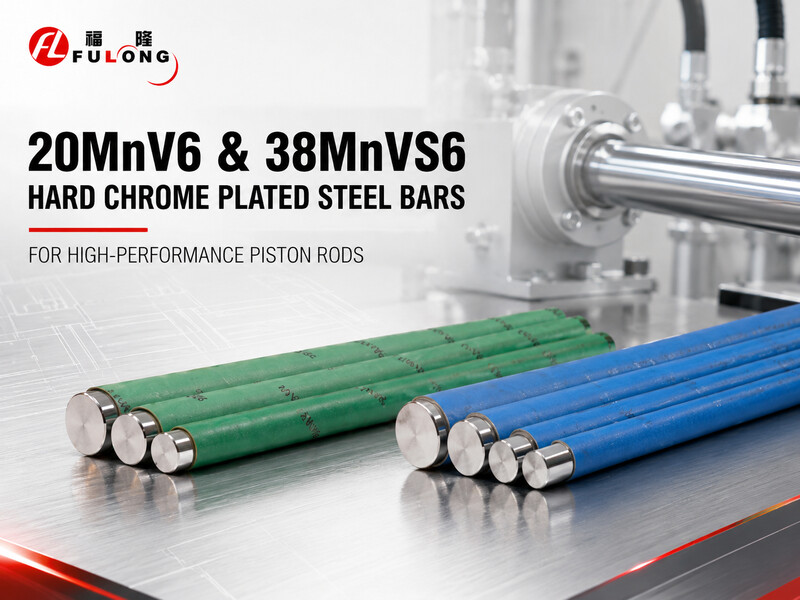
20MnV6 and 38MnVS6 are used for piston rod applications because they provide different but valuable combinations of strength, toughness, machinability, and dimensional stability. In general, 20MnV6 emphasizes toughness, impact resistance, weldability, and processing flexibility, while 38MnVS6 provides higher strength, load-bearing capability, and enhanced machinability. Hard chrome plating gives both materials the surface hardness, finish, wear resistance, and corrosion protection required for reciprocating rod applications.
At Fu-Long Metal Industrial Co., Ltd., we manufacture 20MnV6 and 38MnVS6 hard chrome plated steel bars for piston rods and linear shafts. We also provide separate induction hardened hard chrome plated versions for applications that require a hardened subsurface layer beneath the chrome-plated working surface.
This article explains the characteristics of both materials, their main differences, the role of hard chrome plating, and the information buyers should evaluate when specifying a steel bar for a piston rod.
1. Why Material Selection Matters for High-Performance Piston Rods
A piston rod transfers force between the piston inside a cylinder and the external mechanism being moved. During extension and retraction, the rod must maintain its geometry while passing repeatedly through seals, bearings, and guide components.
Depending on the equipment, a piston rod may be exposed to tensile and compressive loads, impact, vibration, side loading, contaminants, and outdoor operating conditions. Its material must therefore provide the mechanical properties needed to support the rod structure throughout repeated operating cycles.
Hard chrome plating improves the working surface, but it does not replace the mechanical role of the steel substrate. The base material still affects how the rod responds to load, impact, machining, welding, and heat treatment.
Important piston rod material requirements include:
- Strength and load-bearing capability
- Toughness and impact resistance
- Stability under repeated loading
- Machinability and fabrication requirements
- Dimensional stability and straightness
- Compatibility with the required surface treatment
A suitable material must be selected according to the complete cylinder design rather than the steel grade name alone. Rod diameter, length, mounting arrangement, load direction, operating environment, and expected service life must all be considered.
2. What Is a 20MnV6 Hard Chrome Plated Steel Bar?
20MnV6 is a low-carbon manganese-vanadium steel known for its toughness, impact resistance, machinability, and fabrication flexibility. It is suitable for shafts and piston rods that may experience changing loads, vibration, or impact during operation.
Manganese and vanadium help improve the material's mechanical properties while allowing it to retain the toughness associated with a relatively low-carbon composition. This balance is useful when a piston rod must absorb dynamic loading without becoming unnecessarily brittle.
20MnV6 also offers good machining performance for turning, milling, and drilling. This supports the production of threads, shoulders, grooves, mounting sections, and other features commonly required on machined piston rods and shafts.
Another advantage is its favorable weldability. This can be valuable when a shaft design involves welded assembly or other fabrication processes. However, the welding procedure must still be determined according to the material condition, rod dimensions, joint design, and required mechanical properties.
When hard chrome plating is applied, the finished steel bar combines the toughness of the 20MnV6 substrate with a hard and precisely finished external surface. The chrome layer improves resistance to sliding wear and corrosion while providing the smooth running surface required for seal contact.
Key Characteristics of 20MnV6
- High toughness and impact resistance
- Suitable for dynamic loads and vibration
- Moderate strength with good structural stability
- Good machinability
- Favorable weldability
- Good response to appropriate heat treatment
- Dimensional stability during manufacturing
- Compatibility with hard chrome plating
Final performance depends on the material condition, rod dimensions, machining quality, chrome-plating specification, and actual operating requirements.
3. What Is a 38MnVS6 Hard Chrome Plated Steel Bar?
38MnVS6 is a medium-carbon manganese-vanadium-sulfur steel that provides a strong balance of strength, toughness, and machinability. It is commonly considered for piston rods and shaft components that require greater load-bearing capability while maintaining efficient machining performance.
The controlled sulfur content improves machinability, supporting turning, milling, and drilling of precision shaft features. This can be valuable in repeat production or when a piston rod requires multiple machined sections.
38MnVS6 also responds well to appropriate heat treatment. Its hardness and mechanical properties can be adjusted according to the required application. The selected heat-treatment condition must nevertheless be evaluated together with machining, straightness, dimensional stability, and final surface requirements.
Although 38MnVS6 can be welded under suitable conditions, it requires greater process control than a readily weldable low-carbon steel. Depending on the rod dimensions, joint design, and welding procedure, preheating or post-weld treatment may be required to control cracking or localized hardening in the heat-affected zone.
When combined with hard chrome plating, the 38MnVS6 substrate provides structural strength beneath a hard and precisely finished working surface. This combination can support piston rod and shaft applications involving high loads and demanding mechanical conditions.
Key Characteristics of 38MnVS6
- High strength and hardness
- Good toughness under demanding loads
- Enhanced machinability
- Good response to appropriate heat treatment
- Dimensional stability for precision shaft production
- Suitability for high-load mechanical components
- Compatibility with hard chrome plating
For a standard hard chrome plated steel bar, much of the working-surface wear protection comes from the chrome layer. When greater subsurface hardness is required, an induction hardened hard chrome plated version should be evaluated as a separate product option.
4. 20MnV6 vs. 38MnVS6: What Are the Key Differences?
The main difference is that 20MnV6 emphasizes toughness, impact resistance, and fabrication flexibility, while 38MnVS6 places greater emphasis on strength, load-bearing capability, and machinability.
Neither material is universally better. Each grade supports a different balance of performance and manufacturing requirements.
| Comparison Factor | 20MnV6 | 38MnVS6 |
|---|---|---|
| Steel classification | Low-carbon manganese-vanadium steel | Medium-carbon manganese-vanadium-sulfur steel |
| Primary emphasis | Toughness and impact resistance | Strength and load-bearing capability |
| Dynamic loading | Suitable for impact, vibration, and changing loads | Suitable for demanding loads when strength is a priority |
| Machinability | Good | Enhanced by controlled sulfur content |
| Weldability | Generally favorable | Requires greater process control |
| Heat-treatment response | Can be optimized through appropriate treatment | Supports controlled adjustment of strength and hardness |
| Typical selection direction | Dynamic loading, fabrication flexibility, and welded assembly | Higher load requirements and precision-machined shaft components |
The comparison table is an initial reference rather than a final selection rule. Rod diameter, unsupported length, mounting arrangement, loading direction, heat-treatment condition, and cylinder geometry can all influence the correct material choice.
Key Selection Principles
- Evaluate toughness as well as strength.
- Consider impact, vibration, and side loading.
- Review machining and welding requirements.
- Confirm the supplied material and heat-treatment condition.
- Evaluate the material together with rod geometry and surface specifications.
5. How Does Hard Chrome Plating Improve Piston Rod Performance?
Hard chrome plating improves the working surface of a piston rod by adding a high-hardness chromium layer over the steel substrate. After plating, precision grinding, and finishing, the bar can provide the smooth and dimensionally controlled surface required for hydraulic and pneumatic sealing systems.
The chrome-plated surface helps resist friction and sliding wear as the rod travels through seals, bearings, and guide components. It also improves corrosion resistance, although actual corrosion performance depends on factors such as chrome thickness, plating quality, base material, surface preparation, and exposure conditions.
Main Functions of Hard Chrome Plating
- Increases surface hardness
- Improves resistance to sliding wear
- Improves corrosion resistance
- Supports smooth reciprocating motion
- Provides a controlled sealing surface
- Helps reduce surface-related seal damage
- Supports long-term dimensional consistency
For Fu-Long's standard 20MnV6 and 38MnVS6 hard chrome plated steel bars, published product characteristics include:
| Product Characteristic | Published Value |
|---|---|
| Chrome layer thickness below Ø20 mm | 15 μm minimum |
| Chrome layer thickness at or above Ø20 mm | 20 μm minimum |
| Chrome layer hardness | HV 850 minimum |
| Surface roughness | Ra 0.2 μm maximum |
| Outside-diameter tolerance options | ISO h7, f7, h8, f8, and g6 |
| Straightness | 0.3 mm/m |
| Roundness | One-half of the diameter tolerance |
Actual specifications should be confirmed according to the product, ordered diameter, drawing, and application requirements.
Hard chrome plating and induction hardening perform different functions. Hard chrome plating adds an external chromium layer. Induction hardening modifies the steel beneath the surface to create a deeper hardened layer.
Fu-Long supplies standard hard chrome plated steel bars and separate induction hardened hard chrome plated versions. The induction hardened option should be specified only when the application requires additional subsurface hardness or support under demanding loading and wear conditions.
6. Which Piston Rod Applications Are Suitable for 20MnV6 and 38MnVS6?
20MnV6 and 38MnVS6 hard chrome plated steel bars can be considered for piston rods and mechanical shafts used in demanding equipment. Their suitability depends on the rod dimensions, load profile, manufacturing requirements, surface specifications, and operating environment.
Application areas consistent with Fu-Long's product and industry coverage include:
- Hydraulic cylinders
- Pneumatic cylinders
- Construction machinery
- Agricultural machinery
- Mining equipment
- Lift platforms
- Injection molding machines
- Heavy machinery
- Industrial automation equipment
- Other piston rod and linear shaft applications
Construction and mining equipment may expose piston rods to impact, contamination, outdoor conditions, and changing loads. Agricultural machinery may involve vibration, moisture, and repeated movement. Lift platforms require stable movement under load, while injection molding and automation equipment may place greater emphasis on dimensional consistency and smooth reciprocating motion.
These examples do not create a fixed relationship between one industry and one material. Two piston rods used in the same type of equipment may require different steel grades because of differences in load, diameter, stroke, mounting, or operating environment.
Application Conditions to Confirm
- Load level and loading direction
- Shock, vibration, or side loading
- Rod diameter and unsupported length
- Stroke and movement frequency
- Operating environment
- Machining and assembly requirements
- Required maintenance interval and service life
7. How to Specify the Right Hard Chrome Plated Steel Bar
After identifying the operating requirements, buyers should define the material, dimensions, tolerances, and surface structure needed for the piston rod.
A practical specification process can be divided into three steps.
Step 1: Confirm the Operating Conditions
- Load and load direction
- Impact and vibration
- Stroke and movement frequency
- Side-loading risk
- Moisture, chemicals, or contamination
- Expected service life
Step 2: Determine the Material and Surface Structure
- 20MnV6 or 38MnVS6
- Required material condition
- Standard hard chrome plated structure
- Induction hardened hard chrome plated structure, if required
- Required chrome thickness and surface finish
Step 3: Define Dimensions and Processing Requirements
- Product drawing
- Diameter and length
- Dimensional tolerance
- Straightness and roundness
- Surface roughness
- Machined features
- Required quantity
- Inspection or documentation requirements
Fu-Long manufactures 20MnV6 and 38MnVS6 hard chrome plated steel bars, as well as induction hardened hard chrome plated versions. Our documented production capabilities cover material preparation, machining, grinding, hard chrome plating, induction hardening where specified, inspection, packaging, customized product specifications, and export support.
Providing complete technical information helps us confirm the requested material, dimensions, surface requirements, and processing scope more efficiently.
8. Frequently Asked Questions About 20MnV6 and 38MnVS6 Piston Rods
What is the main difference between 20MnV6 and 38MnVS6?
20MnV6 emphasizes toughness, impact resistance, favorable weldability, and processing flexibility. 38MnVS6 places greater emphasis on strength, load-bearing capability, and enhanced machinability. The correct choice depends on the rod design, manufacturing process, and operating conditions.
Is 20MnV6 suitable for hydraulic piston rods?
Yes. 20MnV6 can be used for hydraulic piston rods where toughness, impact resistance, machinability, and dimensional stability are important. Hard chrome plating provides the finished working surface needed for sliding and sealing contact.
When should 38MnVS6 be considered for a piston rod?
38MnVS6 may be considered when higher strength, load-bearing capability, and efficient machining are priorities. Its suitability must still be confirmed according to the rod dimensions, material condition, load profile, and cylinder design.
Why are 20MnV6 and 38MnVS6 piston rods hard chrome plated?
Hard chrome plating increases surface hardness, improves resistance to sliding wear and corrosion, and provides a smooth, controlled surface for reciprocating movement and seal contact.
Are all 20MnV6 and 38MnVS6 hard chrome plated steel bars induction hardened?
No. Standard hard chrome plated steel bars and induction hardened hard chrome plated steel bars are separate product options. The appropriate structure depends on the required subsurface hardness, load, wear conditions, and application design.
Technical References
For additional engineering context, refer to these independent technical sources:
Selecting the Right Material for Piston Rod Production
20MnV6 and 38MnVS6 support different piston rod requirements. 20MnV6 is particularly valuable when toughness, impact resistance, weldability, and processing flexibility are important. 38MnVS6 is suitable for consideration when strength, load-bearing capability, and efficient precision machining are priorities.
The final selection should also account for rod dimensions, loading conditions, surface specifications, processing requirements, and operating environment. Standard hard chrome plated and induction hardened hard chrome plated products must be treated as separate specifications.
Fu-Long Metal Industrial Co., Ltd. manufactures piston rods and hard chrome plated steel bars for hydraulic cylinders, pneumatic cylinders, machinery components, and demanding industrial applications. If you are sourcing 20MnV6 or 38MnVS6 hard chrome plated steel bars, please contact us with your drawing, material grade, dimensions, tolerances, surface requirements, and required quantity.
Discuss Your Piston Rod Requirements with Fu-Long
Send us your drawing, material grade, dimensions, tolerances, surface requirements, and required quantity. Our team can help confirm the appropriate hard chrome plated steel bar and processing scope for your application.
Contact Fu-LongMore Articles
- 5 Key Factors That Determine Piston Rod Performance in Hydraulic Cylinders
- What Are Hard Chrome Plated Steel Bars? Properties, Applications, and Benefits
- Hard Chrome vs. Induction Hardened Steel Bars: A Practical Selection Guide
- How to Choose the Right Hard Chrome Bar Manufacturer: 5 Essential Criteria