

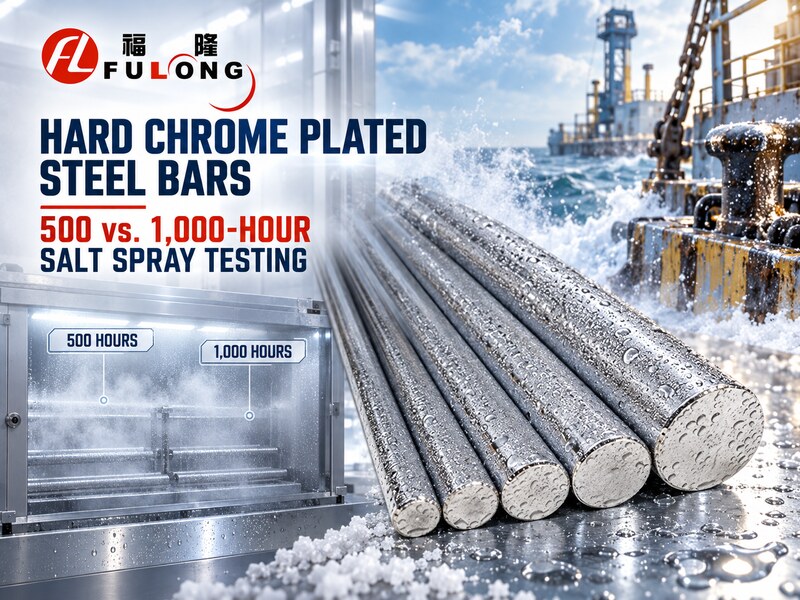
Hard chrome plated steel bars used for piston rods may be exposed to rain, moisture, salt, mud, industrial contaminants, or cleaning chemicals. Under these conditions, selecting a steel bar based only on its material, diameter, or chrome plating thickness may overlook another important requirement: the level of corrosion resistance needed for the actual operating environment.
A 500- or 1,000-hour salt spray requirement indicates how long a specimen must remain in a controlled test environment before its surface is evaluated. A longer test duration represents a more demanding corrosion-resistance requirement, but it is not a direct estimate of field service life.
We can provide products that achieve corrosion-resistance performance exceeding Grade 9 after 120, 200, 500, or 1,000 hours of ISO 9227 neutral salt spray testing. The appropriate specification should be selected according to environmental exposure, maintenance accessibility, the consequences of corrosion-related failure, and the evaluation criteria required by the project.
500- vs. 1,000-Hour Salt Spray Testing: What Is the Difference?
The main difference is the length of time the plated surface is exposed to a controlled salt spray environment before evaluation. Compared with a 500-hour requirement, a 1,000-hour requirement evaluates the surface after a longer period of salt spray exposure.
However, this does not mean that a 1,000-hour requirement is necessary for every application. For some outdoor equipment or high-humidity environments, a 500-hour requirement may provide an appropriate level of corrosion resistance. A 1,000-hour requirement may be considered when equipment is frequently exposed to salt, operates in a more severe environment, is difficult to maintain, or could cause substantial downtime if corrosion-related failure occurs.
| Selection Factor | 500-Hour Requirement | 1,000-Hour Requirement |
|---|---|---|
| Controlled exposure | 500 hours | 1,000 hours |
| General direction | Demanding outdoor or high-humidity conditions | More prolonged or severe corrosive exposure |
| Salt exposure | Intermittent or moderate, depending on the application | Frequent or sustained, depending on the application |
| Maintenance | Regular inspection and maintenance are available | Inspection, maintenance, or replacement is difficult |
| Failure impact | Relatively manageable | Downtime or replacement costs may be higher |
| Procurement focus | Balances performance with project requirements | Meets more demanding corrosion specifications |
This comparison is a general selection reference. Final requirements should follow the customer’s drawings, evaluation criteria, and technical specifications.
- The main difference is the duration of controlled test exposure.
- Not every application requires the longer test duration.
- Results should only be compared when test methods and evaluation conditions are consistent.
What Do ISO 9227 NSS Test Hours and Corrosion Ratings Mean?
ISO 9227 specifies controlled salt spray test methods used to evaluate metallic materials and protective coatings. These methods include the neutral salt spray test, commonly abbreviated as NSS.
During an NSS test, a prepared specimen is placed in a controlled salt spray environment. After the specified test duration, its surface is inspected according to the evaluation method and acceptance criteria agreed upon for the product or project.
This testing can help detect pores, discontinuities, coating defects, and other quality variations that may affect corrosion resistance. It can also support the evaluation of process consistency between production runs or batches.
However, ISO 9227 primarily defines how salt spray testing is performed. It does not establish one universal exposure duration, specimen type, corrosion grade, or pass/fail criterion for every industrial product. These requirements must be defined separately.
We can provide products that achieve corrosion-resistance performance exceeding Grade 9 after 120, 200, 500, or 1,000 hours of ISO 9227 NSS testing. For individual orders, we confirm the required duration, evaluation method, corrosion grade, and inspection documentation before production to ensure that the product specifications meet the project requirements.
Salt spray test results cannot be directly converted into years of outdoor service. Actual corrosion is also influenced by temperature changes, wet-and-dry cycles, contaminants, mechanical damage, equipment design, cleaning methods, and maintenance conditions.
- ISO 9227 NSS provides a controlled corrosion-testing method.
- It does not prescribe the same test duration for every product.
- Test duration and corrosion grade require clear acceptance criteria.
- Salt spray hours do not directly predict actual service life.
How Do You Choose Between 500 and 1,000 Hours?
Industry type alone is not enough to determine the required test duration. Even two hydraulic piston rods used in the same industry may require different corrosion-resistance specifications because of differences in installation, environmental exposure, and maintenance conditions.
Water and Humidity Exposure
Determine whether the bar will operate indoors, under cover, outdoors, or where condensation occurs frequently. Occasional rain exposure creates different risks from continuous moisture or high humidity.
Salt and Coastal Exposure
Equipment near coastlines, ports, or saltwater operations may be exposed to airborne chlorides or direct salt spray. Evaluate the frequency, duration, and severity of exposure.
Chemical Exposure
Acids, alkalis, process fluids, and cleaning agents may affect a component differently from neutral salt spray. Identify substances that may contact the bar rather than assuming NSS represents resistance to every corrosive chemical.
Maintenance Accessibility
A piston rod that can be regularly cleaned, inspected, and lubricated may have different requirements from one installed in a remote, enclosed, or difficult-to-access location.
Consequences of Corrosion
Corrosion may damage the sealing interface, accelerate seal wear, and increase the risk of hydraulic fluid leakage. More demanding specifications may be appropriate if failure could affect safety or cause extended downtime.
Project Specifications
If drawings or procurement specifications define the duration, evaluation method, and acceptance criteria, those requirements should take priority. We will then evaluate whether the complete specification can be achieved.
- Evaluate the actual installation environment.
- Identify exposure to humidity, salt, chemicals, and outdoor contaminants.
- Consider maintenance access and the consequences of failure.
- Confirm final requirements through drawings and technical specifications.
Which Applications Need High Corrosion Resistant Piston Rods?
High corrosion resistant hard chrome plated steel bars are valuable when rod surfaces must remain smooth and dimensionally stable under moisture or corrosive exposure. We primarily provide these bars for hydraulic cylinders, automotive components, and other machinery requiring durability and corrosion resistance.
Outdoor Construction Machinery
Excavators, bulldozers, cranes, and other construction machinery may operate in rain, mud, dust, and changing weather. Exposed hydraulic piston rods must maintain a surface suitable for sealing during repeated movement.
Explore construction applicationsAgricultural Equipment
Tractors, harvesters, sprayers, balers, and other agricultural machinery may face high humidity, mud, outdoor storage, fertilizers, and seasonal conditions.
Explore agricultural applicationsMining and Heavy Equipment
Mining equipment frequently operates around moisture, abrasive contaminants, vibration, and heavy loads. Corrosion resistance should be evaluated together with wear, impact, and mechanical strength.
Explore mining equipment applicationsLift Platforms and Aerial Work Vehicles
Hydraulic cylinders in lift platforms undergo repeated extension and retraction. Corrosion or surface damage may affect seal contact and increase maintenance needs.
Explore lift platform applicationsMarine, Coastal, and Outdoor Equipment
Airborne chlorides, direct salt spray, and persistent humidity can create demanding corrosion conditions. A 1,000-hour requirement may be considered according to exposure and project specifications.
Automotive Components and Industrial Machinery
These components may contact water, coolant, cleaning agents, or corrosive process environments. Protection should be selected according to installation and operating conditions.
The appropriate test duration should be determined by the actual exposure conditions and project specifications for each application.
What Should Buyers Specify When Ordering Corrosion-Resistant Chrome Rods?
A request stating only “500-hour chrome bar” or “1,000-hour piston rod” may not provide enough information for a complete technical evaluation and quotation. Test duration is important, but it is only one part of the overall product specification.
- Required base material or material grade
- Rod diameter and length
- Dimensional tolerance
- Straightness requirement
- Surface roughness
- Chrome plating thickness
- Hardness requirement
- Required ISO 9227 NSS test duration
- Corrosion grade and acceptance criteria
- Test report or inspection-document requirements
- Actual operating environment
- Exposure to salt, humidity, acids, alkalis, or other chemicals
- Additional machining requirements
- Drawings, order quantity, and delivery requirements
When comparing chrome bar suppliers or chrome rod manufacturers, buyers should confirm whether the stated test duration is supported by clearly defined evaluation methods and acceptance criteria.
We provide material preparation, machining, grinding, hard chrome plating, induction hardening, inspection, packaging, and export support according to different product requirements. Our horizontal rotation electroplating process keeps axial workpieces rotating during plating, helping achieve more uniform coating thickness and improved dimensional tolerance control.
If your application requires greater corrosion resistance, you can discuss 500- or 1,000-hour ISO 9227 NSS requirements with us. Based on your drawings and project specifications, we will review manufacturing feasibility, test conditions, evaluation criteria, and documentation requirements.
Learn more about our High Corrosion Resistant Hard Chrome Plated Steel Bar or explore our Special Material and Hard Chrome Plated Steel Bar range.
- Do not specify corrosion resistance by test duration alone.
- Include the corrosion grade and post-test acceptance criteria.
- Describe the corrosive media and actual operating conditions.
- Confirm material, dimensions, tolerances, surface roughness, and chrome thickness.
- Provide drawings for customized machining requirements.
Frequently Asked Questions
Does a 1,000-hour salt spray test mean twice the service life of a 500-hour tested product?
No. It only means that the specimen underwent a longer controlled exposure. Actual service life is also affected by operating conditions, surface damage, cleaning, lubrication, sealing conditions, and maintenance.
Is a 500-hour salt spray tested hard chrome rod suitable for outdoor hydraulic cylinders?
It may suit many outdoor applications, but the decision depends on humidity, salt exposure, maintenance frequency, and acceptance criteria. The actual operating conditions should be provided for evaluation.
When should a 1,000-hour corrosion-resistant piston rod be specified?
It may be considered when equipment operates under prolonged or severe corrosive conditions, is difficult to maintain, or could cause serious consequences if corrosion-related failure occurs.
Does ISO 9227 define the required test duration and pass criteria?
No. ISO 9227 defines the testing procedure, but it does not establish a universal test duration or pass criterion for every product. These requirements must be specified separately.
Can hard chrome plated steel bars be customized for different corrosion-resistance requirements?
Yes. We can provide products exceeding Grade 9 after 120, 200, 500, or 1,000 hours of ISO 9227 NSS testing. Materials, dimensions, tolerances, surface roughness, chrome thickness, and machining requirements can also be discussed.
What information should buyers provide when requesting a quotation?
Provide drawings, material grades, dimensions, tolerances, straightness, surface roughness, chrome thickness, salt spray duration, acceptance criteria, operating environment, quantity, and inspection-document requirements.
Select Corrosion Resistance Based on the Actual Application
A 500-hour requirement may be appropriate for demanding outdoor or high-humidity conditions, while a 1,000-hour requirement may be considered for applications involving more severe exposure or higher failure risks. Final selection should reflect the actual operating conditions and complete technical requirements.
We provide hard chrome plated steel bars, hard chrome rods, hydraulic piston rods, and customized machined products for industrial applications. With integrated processing capabilities and ISO 9227 NSS testing options of up to 1,000 hours, we can evaluate product specifications according to customer drawings and operating requirements.
Discuss Your Corrosion-Resistance Requirements with Us
Please provide your drawings, required salt spray test duration, corrosion rating, acceptance criteria, operating environment, quantity, and inspection-document requirements. Our team will review the specifications and manufacturing feasibility for your application.
Contact FU-LONG