
Products
38MnVS6 Induction Hardened Hard Chrome Plated Steel Bar
Description
Through induction hardening, 38MnVS6 steel shafts achieve a superior combination of a high-hardness surface and a ductile core. This makes them exceptionally well-suited for applications requiring high strength, maximum wear resistance, and high fatigue performance.
The primary characteristics include:
1. High Surface Hardness: The induction hardening process significantly increases the surface hardness of 38MnVS6 bars, typically reaching HRC 50–60 or higher. This hardened layer effectively enhances the shaft's wear resistance, making it ideal for high-friction and heavy-load environments such as drive shafts, rotating shafts, and mechanical linkages.
2. Excellent Wear Resistance: The hardened surface layer formed during heat treatment greatly improves the shaft's resistance to abrasion. This characteristic extends the service life of the shaft, allowing it to operate for long periods under high-wear conditions without significant loss of material.
3. Good Core Toughness: Since induction hardening only targets the surface, the interior of the 38MnVS6 bar retains its original toughness and impact resistance. This ensures the shaft can absorb shocks and dynamic loads while maintaining its hard exterior, effectively reducing the risk of brittle fracture.
4. High Fatigue Strength: The residual compressive stress on the surface after hardening helps improve the shaft's fatigue strength. It provides a longer fatigue life in work environments subjected to repeated stress, making it suitable for high-frequency and high-cycle moving parts.
5. Processing Flexibility: Despite the surface hardening, the core remains machinable. This allows for necessary mechanical adjustments or finishing after heat treatment to ensure the shaft meets precise dimensional requirements.
6. Dimensional Stability: Because the thermal impact of induction hardening is localized to the surface, the internal structure remains unaffected. This allows the bar to maintain excellent dimensional stability and precision during both processing and usage.
7. Corrosion Resistance: While the base 38MnVS6 material has standard corrosion resistance, the surface hardening helps mitigate corrosion caused by wear and tear. When combined with surface treatments such as chrome plating or specialized coatings, its corrosion resistance is further enhanced.
In summary, 38MnVS6 Induction Hardened and Hard Chrome Plated Steel Bars perfectly balance surface hardness with core toughness. They are an ideal choice for mechanical applications requiring high wear resistance, high strength, and fatigue resistance. These shafts are particularly effective in high-load, dynamic stress, and high-abrasion environments, such as automotive transmission systems, heavy machinery moving parts, and critical shafts in various precision industrial equipment.
The primary characteristics include:
1. High Surface Hardness: The induction hardening process significantly increases the surface hardness of 38MnVS6 bars, typically reaching HRC 50–60 or higher. This hardened layer effectively enhances the shaft's wear resistance, making it ideal for high-friction and heavy-load environments such as drive shafts, rotating shafts, and mechanical linkages.
2. Excellent Wear Resistance: The hardened surface layer formed during heat treatment greatly improves the shaft's resistance to abrasion. This characteristic extends the service life of the shaft, allowing it to operate for long periods under high-wear conditions without significant loss of material.
3. Good Core Toughness: Since induction hardening only targets the surface, the interior of the 38MnVS6 bar retains its original toughness and impact resistance. This ensures the shaft can absorb shocks and dynamic loads while maintaining its hard exterior, effectively reducing the risk of brittle fracture.
4. High Fatigue Strength: The residual compressive stress on the surface after hardening helps improve the shaft's fatigue strength. It provides a longer fatigue life in work environments subjected to repeated stress, making it suitable for high-frequency and high-cycle moving parts.
5. Processing Flexibility: Despite the surface hardening, the core remains machinable. This allows for necessary mechanical adjustments or finishing after heat treatment to ensure the shaft meets precise dimensional requirements.
6. Dimensional Stability: Because the thermal impact of induction hardening is localized to the surface, the internal structure remains unaffected. This allows the bar to maintain excellent dimensional stability and precision during both processing and usage.
7. Corrosion Resistance: While the base 38MnVS6 material has standard corrosion resistance, the surface hardening helps mitigate corrosion caused by wear and tear. When combined with surface treatments such as chrome plating or specialized coatings, its corrosion resistance is further enhanced.
In summary, 38MnVS6 Induction Hardened and Hard Chrome Plated Steel Bars perfectly balance surface hardness with core toughness. They are an ideal choice for mechanical applications requiring high wear resistance, high strength, and fatigue resistance. These shafts are particularly effective in high-load, dynamic stress, and high-abrasion environments, such as automotive transmission systems, heavy machinery moving parts, and critical shafts in various precision industrial equipment.
Feature
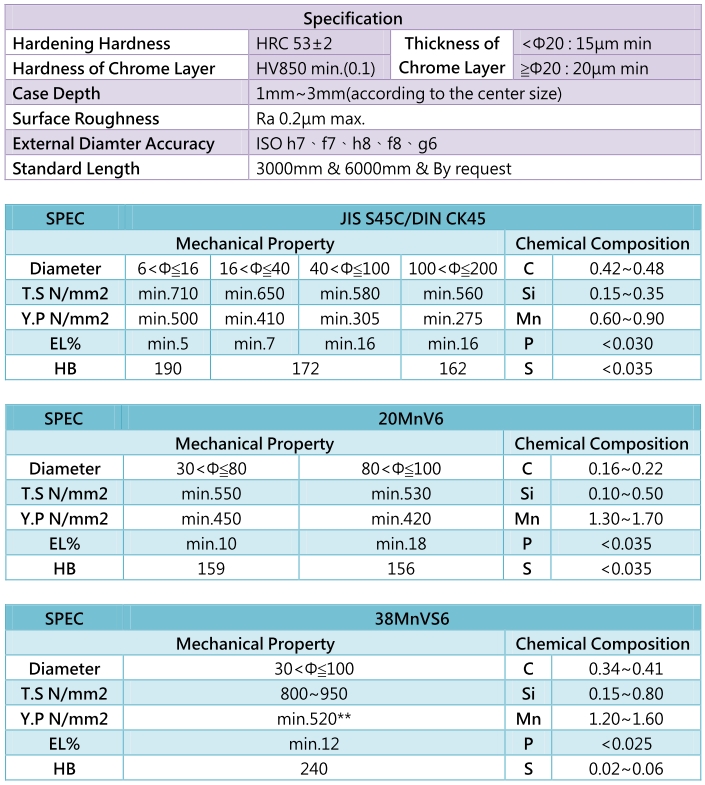
- Material Grade: 38MnVS6
- Induction Hardness: HRC 53 ± 2
- Chrome Layer Thickness: < Φ20: 15μm min. / ≧ Φ20: 20μm min.
- Chrome Layer Hardness: HV 850 min. (0.1)
- Induction Hardening Depth: 1mm–3mm (Depending on center size)
- Surface Roughness: Ra 0.2μm max.
- Outer Diameter Precision: ISO h7, f7, h8, f8, g6
- Standard Length: 3000mm & 6000mm
Specification